CAP30 Play

The fast-paced card game that really adds up

A free maths card game for families, made by a dad to help his daughter with her number bonds.

100% freeNo sign-upNo adsNo cookiesNo personal dataPhone, tablet or computer
What is Cap30?

One total. Everyone shares it.

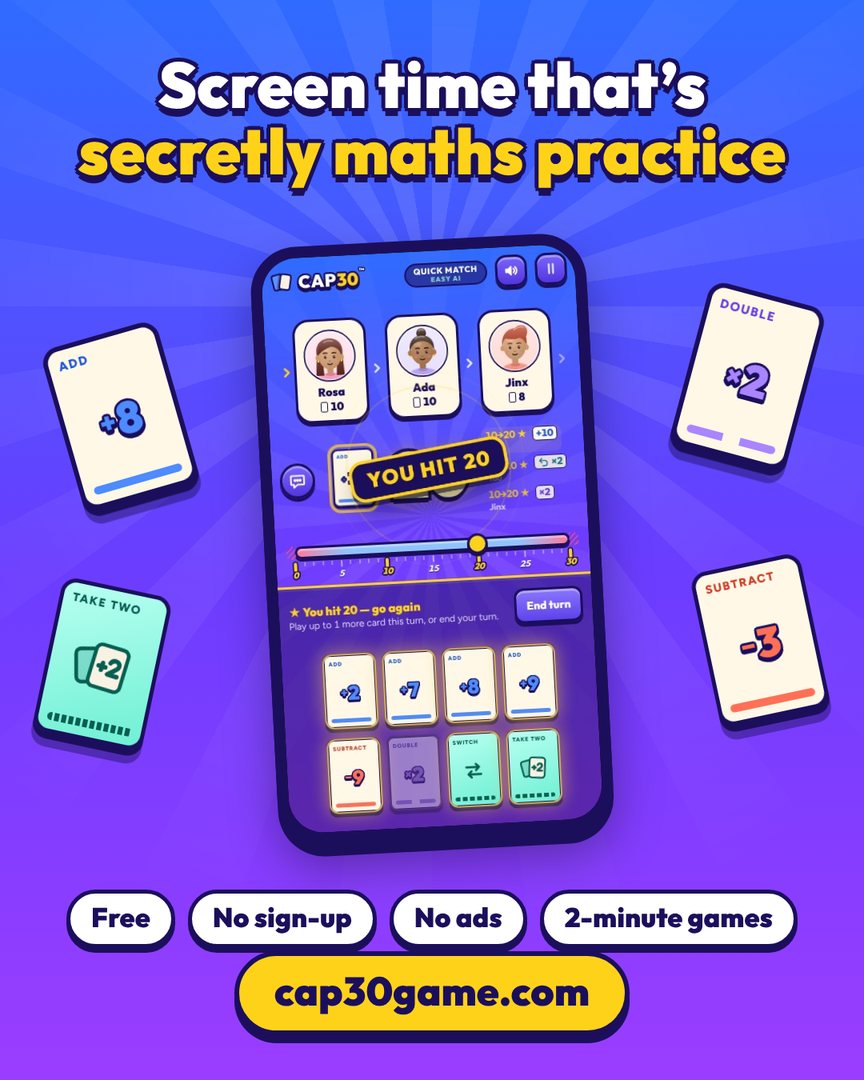
Cap30 is a quick card game you play in your browser. There's one shared total, and every card you play moves it up or down.

Add and subtract cards push it around, double and halve cards make it jump, and you can never go below 0 or above 30. Land exactly on a ten (0, 10, 20 or 30) and you get another go, up to three in a row.

Then there's the usual rogues' gallery of action cards: Skip, Switch direction and Take Two. The first player to empty their hand wins. A game takes about two minutes, so there's always time for a rematch.

Play against the computer, or make a private room and play with up to three friends or family members on their own devices.

Try a game now

20 seconds of real play

My story

Made for my daughter

My daughter has been learning her number bonds at school: the pairs that make 10, like 3 and 7, or 6 and 4. It's the kind of thing that clicks with lots of practice, and practice is a hard sell when you could be playing instead.

So I thought: what if the practice was the playing?

I designed Cap30 to sneak the maths in. Every turn is a small sum, and the best moves are the ones that land on a ten, which is number bonds by stealth. To keep it fun, I added the things that make card games exciting: action cards, chains of moves and a race to empty your hand.

She enjoys it, and honestly, so do I. It's become our quick after-tea game, and it's free for every family that wants it.

— Cap30's maker, and a dad
The secret maths

Every move is a little sum

Children don't sit down to "do maths" in Cap30. They play to win, and winning means doing the sums.

In the game

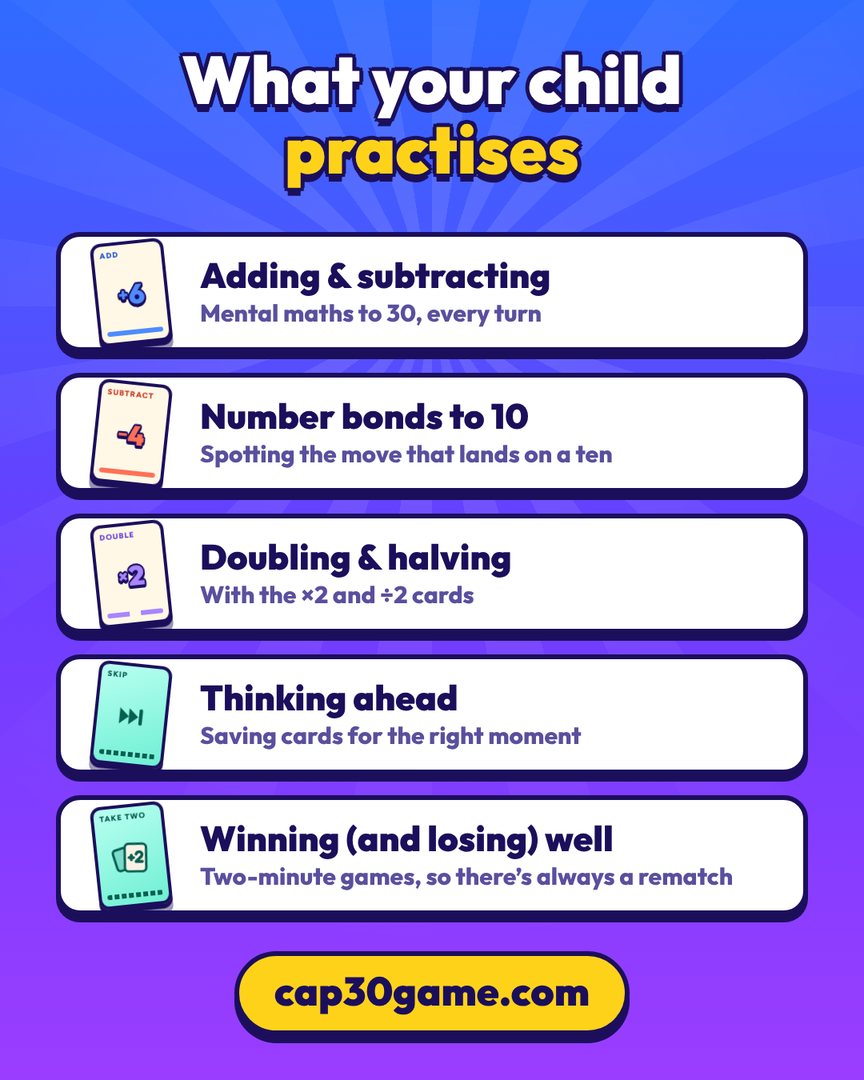
Add & subtract cards

Mental addition and subtraction within 30, on every turn, without a worksheet in sight.

In the game

Land on a ten, go again

Number bonds to 10 and to the next ten: from 17, which card makes 20? Spotting it is how you win.

In the game

Double & halve cards

Doubling and halving numbers up to 30, and checking whether the answer still fits.

In the game

Never below 0 or above 30

Estimating and checking before you play: "If I add 8 to 25, that's too much."

In the game

Action cards & chains

Thinking a move ahead: saving a Skip for the right moment, or lining up three tens in a row.

In the game

Two-minute games

Lots of short games means lots of practice, and losing just means "rematch!"

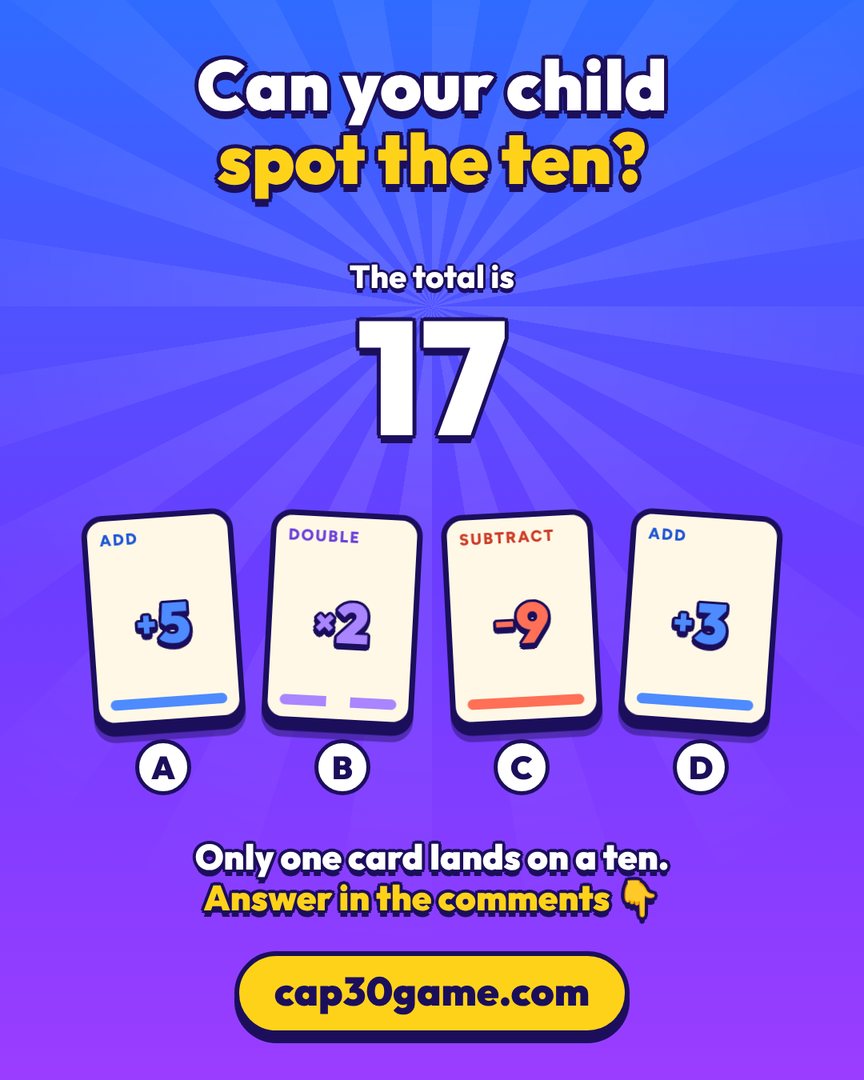
Puzzle: the total is 17. Cards: A plus 5, B double, C minus 9, D plus 3. Which one lands on a ten?

Try one with your child

The total is 17. Which card lands it exactly on a ten?

Show the answer

D, +3 makes 20. A makes 22, C makes 8, and B doubles it to 34, which goes past 30, so it can't be played.

How to play

Learn it in one game

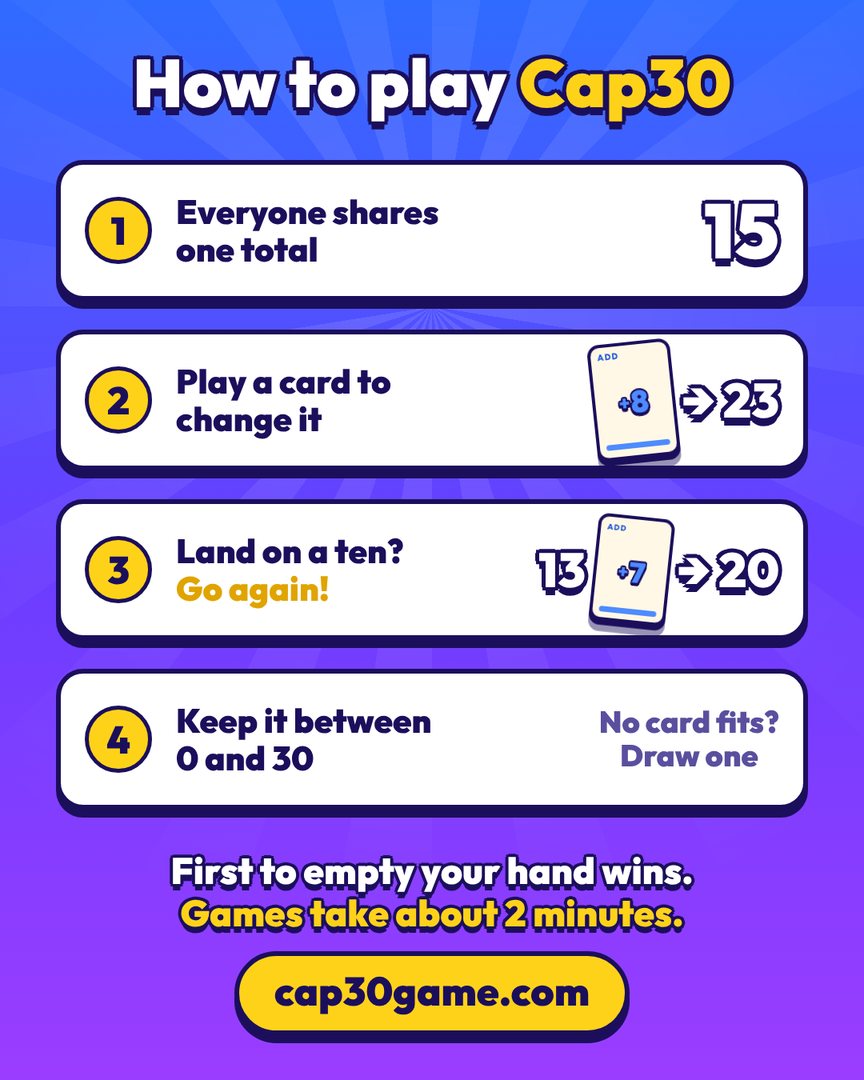
  1. Everyone shares one totalIt starts at 15.
  2. Play a card to change itAdd, subtract, double or halve.
  3. Land on a ten? Go again!0, 10, 20 or 30, up to three in a row.
  4. Keep it between 0 and 30A card that would go past either end can't be played. If nothing fits, draw a card.
  5. Empty your hand to winAction cards like Skip and Take Two keep everyone on their toes.

There's a one-minute guided tutorial in the game too.

Ways to play

Family

The simple version, great for younger players. Starts on Easy.

Power Up

For older kids and grown-ups: a power meter, bigger rewards for hitting tens, and first to win 2 or 3 hands.

Play together

Make a private room and share the code to play with up to 3 others on their own phones or tablets.

Expansion packs

The 50 Pack (numbers to 15) and 100 Pack (two-digit sums) for when 30 gets too easy.

Safe & free

Built for kids, safe by design

£0

Free to play, and it will stay free

No data

No names, emails or accounts asked of players

No ads

Nothing to click away to while playing

No cookies

Progress is saved only on your own device

No chat

Only friendly preset reactions, never typed messages

No shop

Nothing to buy or unlock in the game

Privacy and safety in plain English

  • No accounts. Nobody signs up or logs in. Stats and settings live in your own browser, and clearing it clears them.
  • No real names online. In online games, every player gets a made-up name like "Swift Otter". Nobody can type their own name.
  • No messaging. Players can only send preset reactions such as "Nice one! 👏" or "So close! 😅". There's no way to type a message, so there's nothing to moderate.
  • Online play is optional. If nobody else is online, the computer fills the empty seats. For private games you choose who gets your room code.
  • Anonymous counts only. The game counts visits and games played so I can see it's working, without cookies and without storing anyone's IP address.
  • The newsletter is for grown-ups. The only place an email is ever asked for is the box sign-up below. It's handled by Kit, needs you to confirm by email, and you can unsubscribe at any time.
Take a look

Bright, quick and a bit noisy

Coming soon

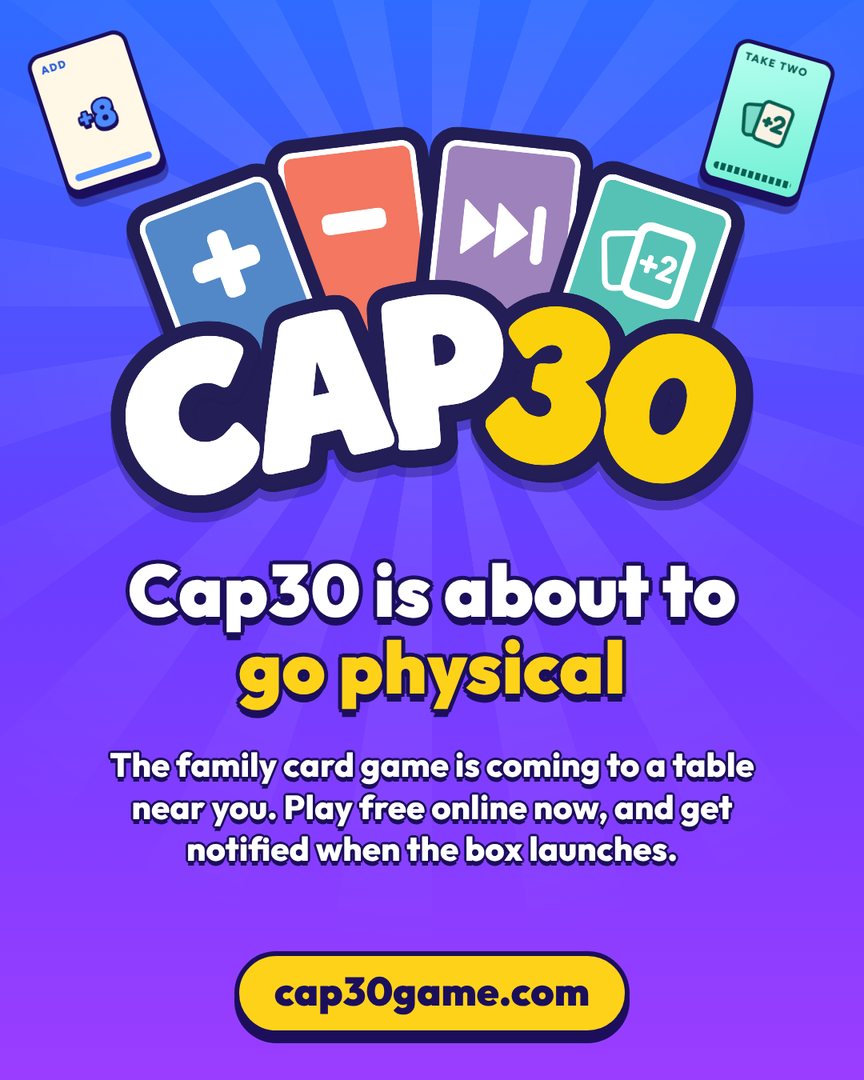
Cap30 is going physical

The boxed Family edition

Cap30 is becoming a real card game for the kitchen table: no screens, same fun. Leave your email and you'll be first to hear when it launches, including pre-sales and the Kickstarter.

The online game stays free as a companion to the box.

For grown-ups. We'll only email you about Cap30 releases. You'll get a confirmation email first, and you can unsubscribe any time. Sign-ups are handled by Kit.

Cap30 is about to go physical
Questions

Good to know

What age is it for?

Family mode suits children who are learning number bonds to 10 and adding within 20, usually around 4 to 8, with a grown-up alongside the youngest. Power Up and the expansion packs stretch older children and adults.

Is it really free?

Yes. There are no ads, no in-game purchases and nothing to unlock. The game will stay free as a companion to the boxed card game.

What do I need to play?

Just a web browser on a phone, tablet or computer. Open cap30game.com and tap Play. Nothing to download or install.

Can my child play online with strangers?

Quick match can pair players with others online, but everyone has a made-up name and can only send preset reactions, so there's no way to share personal details or chat. For complete control, play against the computer or make a private room and share the code only with people you know.

Can teachers use it in class?

Please do. It's free, needs no accounts and works on school tablets and laptops, so it suits a maths warm-up or a number bonds station. I'd love to hear how it goes from anyone who teaches early years or Key Stage 1.

How do I give feedback?

Join the newsletter above and reply to any email: they come straight to me, and I read every one.